Hybrids, Cultivars, and Nativars Explained
The plants that we enjoy from nurseries, hardware stores, other local vendors, or grow ourselves each have a specific name assigned to them. There is a standard classification system which includes the genus and species. This system has been in existence for hundreds of years and is called taxonomy or the classification of plants by their characteristics.¹
The genus is a fundamental rank in biological classification, grouping closely related species that share common characteristics like leaf shape, flower structure, or cone type, forming the first part of a plant's scientific name.
Let’s use as an example the genus Echinacea. It is an herbaceous perennial in the Asteraceae (daisy) family that is native to the central and eastern United States. The Genus name is Greek for meaning 'spiny one' . ²
There are nine commonly accepted species, which are known also as coneflowers. They are native only in eastern and central North America.
Echinacea angustifolia – Narrow-leaf coneflower
Echinacea atrorubens – Topeka purple coneflower
Echinacea laevigata – Smooth coneflower, smooth purple coneflower
Echinacea pallida – Pale purple coneflower
Echinacea paradoxa – Yellow coneflower, Bush's purple coneflower
Echinacea purpurea – Purple coneflower, eastern purple coneflower
Echinacea sanguinea – Sanguine purple coneflower
Echinacea serotina – Narrow-leaved purple coneflower
Echinacea simulata – Wavyleaf purple coneflower
Echinacea tennesseensis – Tennessee coneflower
When listed like the nine above, these are also referred to as “straight species” - these are natives. This is a species that has not been modified in any way – it is the native, wild version of the plant. Of the species above, Echinacea purpurea is the one with which we are likely most familiar.
When you refer to a plant label, it should always include the genus and species, but it may also include another name if the plant is a cultivar. This name is set off by single quotation marks. In the case of Echinacea, a popular cultivar of Echinacea pupurea is Echinacea purpurea 'Magnus'.
Compare Native to Cultivar
(Both available in BCEMGVA Spring Sale)
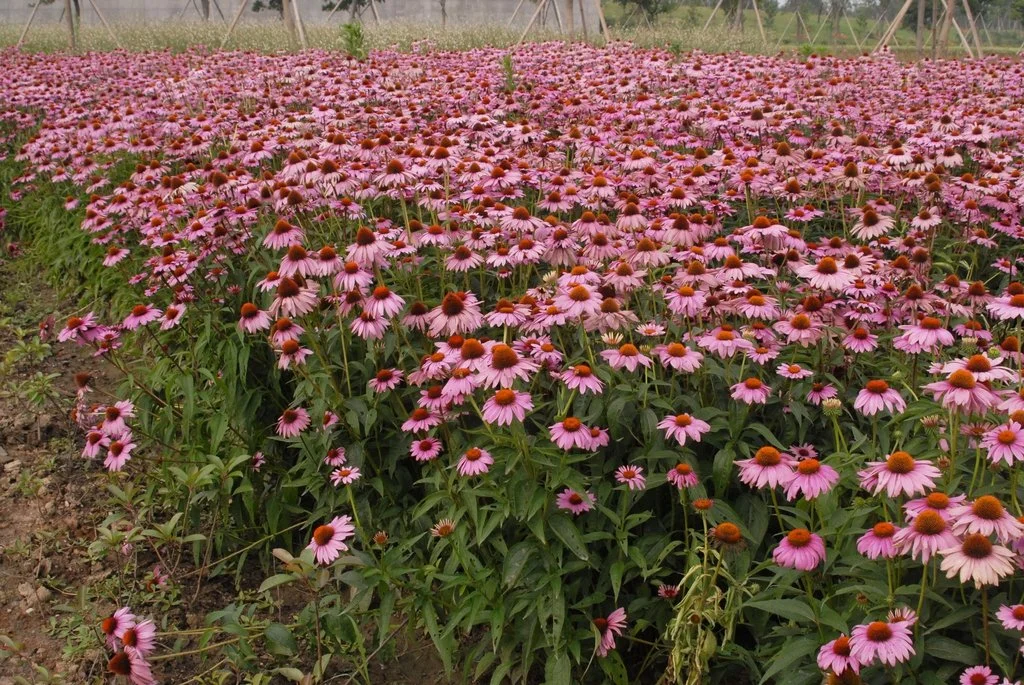
Form, Jim Robbins, CC BY-NC-ND 4.0
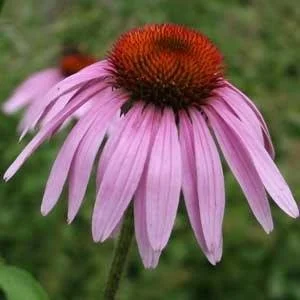
'Magnus' Debbie Roos, CC BY 2.0
Cultivars are the result of human intervention such as plant research carried out by universities and agronomic corporations. Cultivars are developed – as examples - to highlight a specific color, resistance to pests and diseases, or ability to extend the growing season.³
What if there is a naturally occurring variation in a plant? This could be a plant which blooms in light pink that throws off a white blooming plant. In this case, there is no human intervention, only the natural evolution of the species. This is referred to as a “variety” and is often abbreviated on plant labels as “var.”. When grown from seed, a variety will maintain all of its particular characteristics. You may also hear these called a “botanical variety”.
Varieties and cultivars are different and so they also have different naming conventions. A variety is always written in lower case and italicized. It also often has the abbreviation "var." for variety preceding it. The first letter of a cultivar is capitalized and the term is never italicized. Cultivars are also surrounded by single quotation marks (never double quotation marks) or preceded by the abbreviation "cv.". ⁴
With this as a background, we’ll turn to the NCSU Extension Gardener Handbook for further explanation of hybrids and nativars.
Are hybrids and cultivars native?
Do cultivars and hybrids of native plants support ecological functions as well as their wild relatives? Should we label such cultivars and hybrids, sometimes called “nativars,” as native plants? There are no decisive answers to these complex questions.
Cultivars are varieties of a species that are selected because they have larger flowers, shorter stature, extended bloom times, different colored petals or leaves, or some other feature gardeners find desirable. For example, ‘Shamrock’ is an inkberry holly (Ilex glabra) cultivar selected because it is more compact and holds its color better in winter than the wild species.
Hybrids are the result of two closely related plants, typically from the same genus, cross-pollinating and producing a viable offspring. Hybrids inherit genes from both parents and typically exhibit traits that are intermediate of the parent species. Hybrids can occur in nature where the distribution ranges of closely related plants overlap.
Vernonia × georgiana is an example of a naturally occurring hybrid between Vernonia acaulis, stemless ironweed, and Vernonia nudiflora, narrow-leaf ironweed. All species of Vernonia are highly attractive to bees, so this hybrid may also occur in gardens where these species are grown together.
Gardeners and plant breeders intentionally cross two species to create hybrids. Some common reasons landscape plants are intentionally hybridized are to develop disease-resistant strains, to create novel flower or foliage colors, and to improve growth habit or performance in nursery production systems. Many of the new coneflower (Echinacea spp.) varieties with orange, yellow, and red flowers are hybrids between purple coneflower, Echinacea purpurea, and other Echinacea species, including E. angustifolia, E. paradoxa, E. laevigata, and E. tennesseensis. Although we can bring together two species that do not have overlapping native ranges, we cannot cross species that would not naturally do so.⁵
Sources:
1,2,5 NC State Extension. (2022). North Carolina Extension Gardener Handbook (2nd ed., K. Moore & L. Bradley, Eds.). https://content.ces.ncsu.edu/extension-gardener-handbook
3,4 Retrieved at https://yardandgarden.extension.iastate.edu/faq/what-difference-between-cultivar-and-variety

NC State University is an equal opportunity institution