
Hurricane Lily or Spider Lily (Lycoris radiata)
The red Hurricane Lily is a late-summer-blooming perennial bulb in the amaryllis family native to China, Japan, Korea, and Nepal. It is usually found in shady, moist areas along slopes and rocky area near stream banks. This easy-to-grow bulb is described as hardy from zones 6a to 10b, but it can be damaged below 28 degrees F.
The genus name Lycoris is in honor of the Roman actress and mistress of Mark Antony. One of Lycoris’ common names -- Hurricane Lily -- is because it blooms during the height of hurricane season, usually after a heavy rain. Other names for this almost magical flower are Equinox Flower, Surprise Lily, Resurrection Lily, Red Spider Lily, and Naked Lady.
The spidery-looking flowers emerge on 1- to 2-ft.-tall naked scapes in late summer to early fall (before the foliage emerges) as umbels of four to seven showy, bright red tubed blooms. Each bulb can produce one to four flower stems, and each cluster of flowers will last about two weeks if protected from wind and sun. Flowers attract hummingbirds, butterflies, and other pollinators.

'Modern Japanese' at High Point, NC
Scott Zona
CC BY-NC 2.0
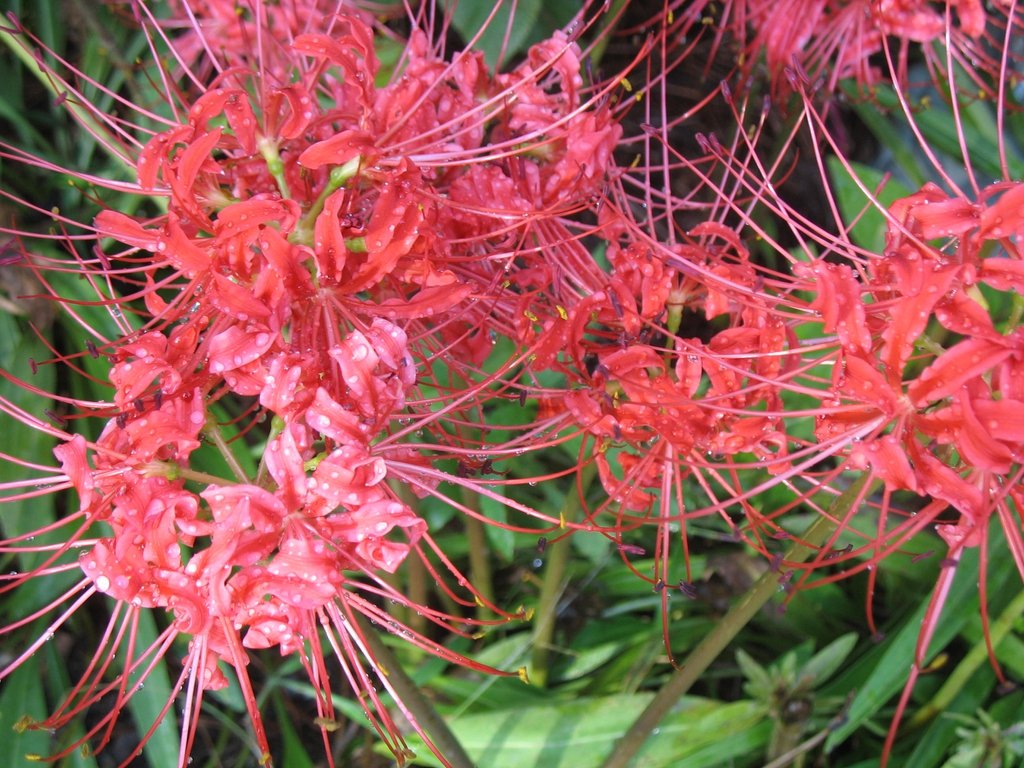
Flower, Charlotte NC
Stacy Hodes
CC BY 4.0
Site the bulbs in full sun to partial shade. The best flowering will occur in partial shade. Plant the bulbs in the fall with the neck exposed, spaced 6- to 12-in. apart in rich, moist, well-drained soil. Avoid overwatering to prevent root rot. In the dormant season, it is best if the soil remains fairly dry.
The bulbs naturalize easily through offsets and are quite long-lived. Over time, the individual bulbs will grow into larger clumps that can be lifted and divided in spring after the leaves turn yellow. Doing this every several years encourages flowering, making them good passalong plants. Be aware that recently divided or newly planted bulbs often won’t flower for a year or more.
Grayish-green leaves emerge in October, remain evergreen over winter, and die back in the spring. Let the foliage die back naturally to build up the stored food supply in the bulbs.
In the landscape, it would be best to incorporate these bulbs in a mixed ground cover or flowerbed so that their starkness will not be so readily apparent. Plant masses along a walkway, in a courtyard garden, in front of a border, or in other small spaces.
Hurricane Lilies have no serious insect or disease problems and are resistant to deer. Narcissus bulb fly occasionally feeds on this species. Avoid overwatering to prevent root rot. Like many other types of garden lilies grown in North Carolina, Hurricane Lilies contain various toxic alkaloids and can cause poisoning if consumed. For more information, consult the end of the “Attributes” section in the Lycoris entry in the NCSU Plant Toolbox.
By Kathryn Copley, Extension Master Gardener℠ Volunteer, Brunswick County, NC
For more information on gardening in Brunswick County, please call the Brunswick County Cooperative Extension Office, 910.253.2610.
👉 Click here for a printable pdf version.
SOURCES:
Lycoris radiata | North Carolina Extension Gardener Plant Toolbox
Spider Lilies | Clemson University Cooperative Extension, Home and Garden Information Center
Hurricane Lily | UF-IFAS Gardening Solutions, University of Florida