
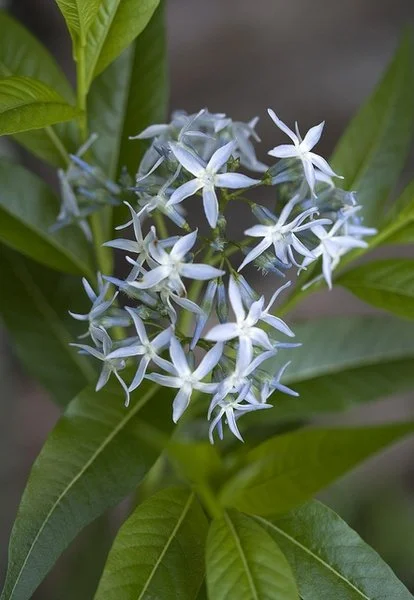
Flower
Jane
CC BY-NC-ND 4.0
Eastern Bluestar is a native herbaceous perennial in the dogbane family native to central and eastern North America and found most often in wet, sandy, rich, open and rocky woods and thickets in zones 3a to 9b. The genus name honors Dr. John Amson, an English physician and amateur botanist who lived and worked in Williamsburg, Va., during the colonial period.
This plant has clusters of ¾ in., light blue, star-like flowers that open in late spring atop erect, leafy stems. They may be hidden by the upper leaves. This plant was selected as the 2006 NC Wildflower of the Year, a program managed by the North Carolina Botanical Garden with some financial support from the Garden Club of North Carolina.
This plant will grow 2- to 3-ft. tall and wide in an erect clumping form in full sun to partial shade. Growing in too much shade or nutrient-rich soil may cause the plant to flop and need staking or pruning. If pruning is necessary, it is recommended to cut the stems back ½ to 1/3 after flowering to promote bushy growth and a more rounded habit.
Plant the crown at soil level in well-drained moist to occasionally wet soils. At planting, water the roots and surrounding area slowly and deeply. Keep soil moist until the plant is established, and then apply enough water to thoroughly moisten the root zone when the soil is dry or during drought. Modify water recommendations to reflect site drainage and rainfall. Apply 3 inches of mulch over the planted area but don’t allow mulch to touch the plant stems.
Use Eastern Bluestar in the border or in native, pollinator, cutting or cottage gardens where they are useful as accent plants, mass plantings, small groups, and as specimen plants. Eastern Bluestar can perform quite well in a rain garden, and it tolerates drought once established. The flowers also make nice cut flowers.
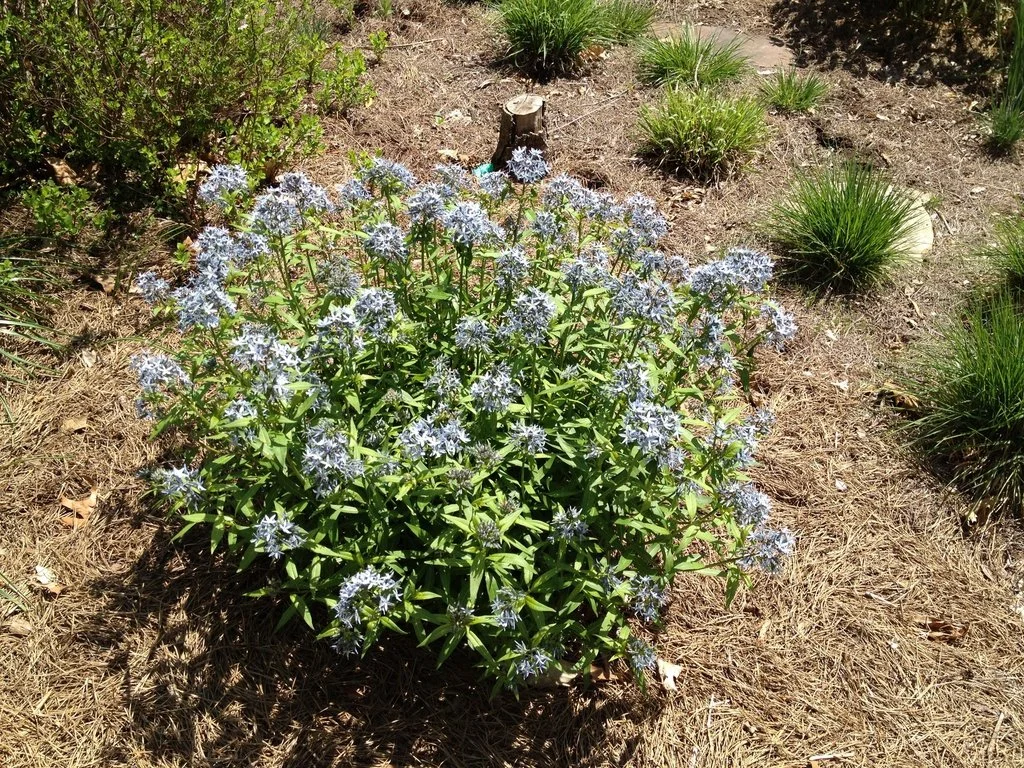
Flower Form
Jim Robbins
CC BY-NC-ND 4.0
Recommended propagation strategies are division, root cuttings, seeds, and stem cuttings. When propagating by seed, the seedlings will germinate quickly, but the plant will not flower until the second year. Deadhead to prevent self-seeding. Division can be accomplished in spring or fall when the plant is dormant, ensuring each division has at least one eye.
Eastern Bluestar has no significant insect, disease, or other plant problems if cultural preferences are met, although rust may occur. The plant has wildlife value to hummingbirds, carpenter bees, hummingbird moths, as well as butterflies like Mourning Cloak that feed on the nectar from the blooms.
Eastern Bluestar is resistant to damage by deer and other herbivores and most pests due to the foliage containing a toxic white latex.
By Kathryn Copley, Extension Master Gardener℠ Volunteer, Brunswick County, NC
For more information on gardening in Brunswick County, please call the Brunswick County Cooperative Extension Office, 910.253.2610.
👉 Click here for a printable pdf version.
SOURCES:
Amsonia tabernaemontana | North Carolina Extension Gardener Plant Toolbox
Bluestar | Clemson University Cooperative Extension, Home and Garden Information Center