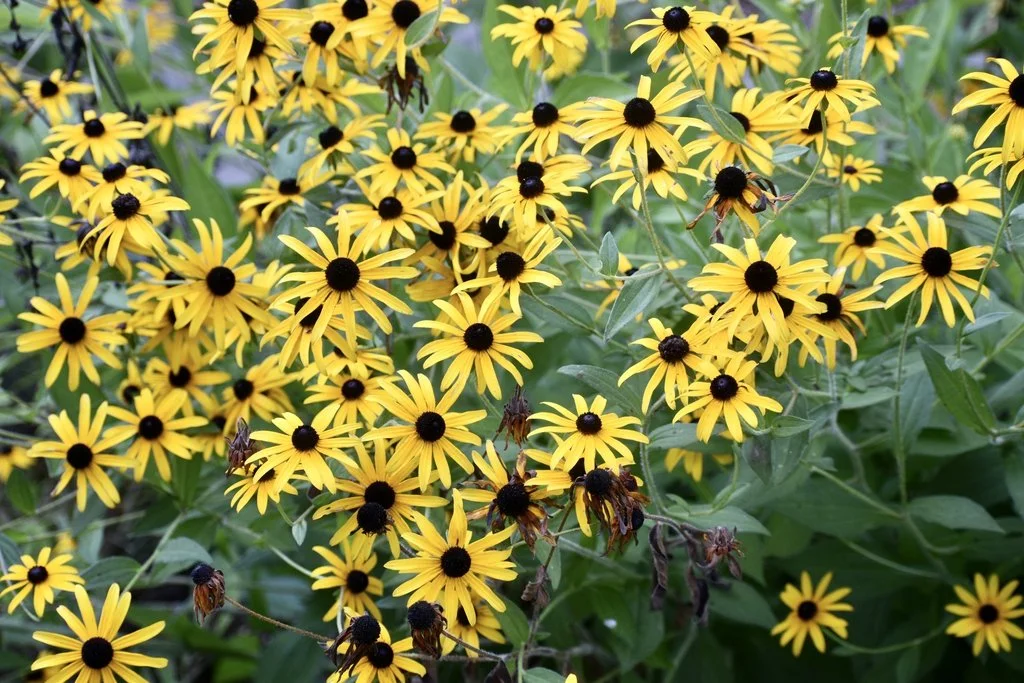
Black-eyed Susan ~ Rudbeckia hirta

$7.00
sold out

Pot Size:  2 quarts
Native Status:  Native 

Description: Black-eyed Susan is a fast-growing, upright, branching biennial or short-lived perennial in moist, well-drained clay, loam, or sandy soil and in full sun to partial shade. Moderate fertility will give you the best flower show so avoid planting it on the edges of lawns where lawn fertilizer will provide excess nitrogen. It freely self-seeds and usually remains in the garden. 

Light Exposure: Full Sun to Part Shade            Drought Tolerant:  Yes
Soil Moisture:  Medium to Dry                           Salt Tolerant:  Yes
Mature Height:  2 – 4 ft                                     Deer Resistant: Yes
Mature Width:  1 – 2 ft                                                    

Bloom Color/Bloom Time:   Blooms golden yellow with dark centers from spring through September.

Historical Uses:   Roots were used to create teas for treating infections, worms in children, and colds. The plant was used to reduce swellings and as a diuretic. Juices from the roots were applied to treat ear aches. Poultices made from the plant were used to treat snakebites, sores, and swelling. It is linked to themes of encouragement and, in some traditions, protection and good fortune. Rudbeckia hirta first documented 1760 in America.

Wildlife Values:  The flowers attract a variety of insect visitors and pollinators as well as a food source for the larvae of the Emerald (Synchlora aerata) and Silvery Checkerspot (Chlosyne nycteis) butterflies. American goldfinches will eat the seeds in the fall.

‍ ‍ ‍‍👉 For more information visit NC Extension Gardener Plant Toolbox

Pot Size:  2 quarts
Native Status:  Native 

Description: Black-eyed Susan is a fast-growing, upright, branching biennial or short-lived perennial in moist, well-drained clay, loam, or sandy soil and in full sun to partial shade. Moderate fertility will give you the best flower show so avoid planting it on the edges of lawns where lawn fertilizer will provide excess nitrogen. It freely self-seeds and usually remains in the garden. 

Light Exposure: Full Sun to Part Shade            Drought Tolerant:  Yes
Soil Moisture:  Medium to Dry                           Salt Tolerant:  Yes
Mature Height:  2 – 4 ft                                     Deer Resistant: Yes
Mature Width:  1 – 2 ft                                                    

Bloom Color/Bloom Time:   Blooms golden yellow with dark centers from spring through September.

Historical Uses:   Roots were used to create teas for treating infections, worms in children, and colds. The plant was used to reduce swellings and as a diuretic. Juices from the roots were applied to treat ear aches. Poultices made from the plant were used to treat snakebites, sores, and swelling. It is linked to themes of encouragement and, in some traditions, protection and good fortune. Rudbeckia hirta first documented 1760 in America.

Wildlife Values:  The flowers attract a variety of insect visitors and pollinators as well as a food source for the larvae of the Emerald (Synchlora aerata) and Silvery Checkerspot (Chlosyne nycteis) butterflies. American goldfinches will eat the seeds in the fall.

‍ ‍ ‍‍👉 For more information visit NC Extension Gardener Plant Toolbox

The information provided here is for educational and informational purposes only and is not intended as medical advice. Medicinal plants can have serious side effects and interactions with medications. Consult your healthcare provider before using any herbal remedies, as you are responsible for your own health decisions.


Photo Credits:

1 - Rudbeckia hirta Composite head detail Debbie Roos
1 - Rudbeckia hirta Flowers - Aug. 12 - Wake Co., NC Cathy DeWitt CC BY 4.0